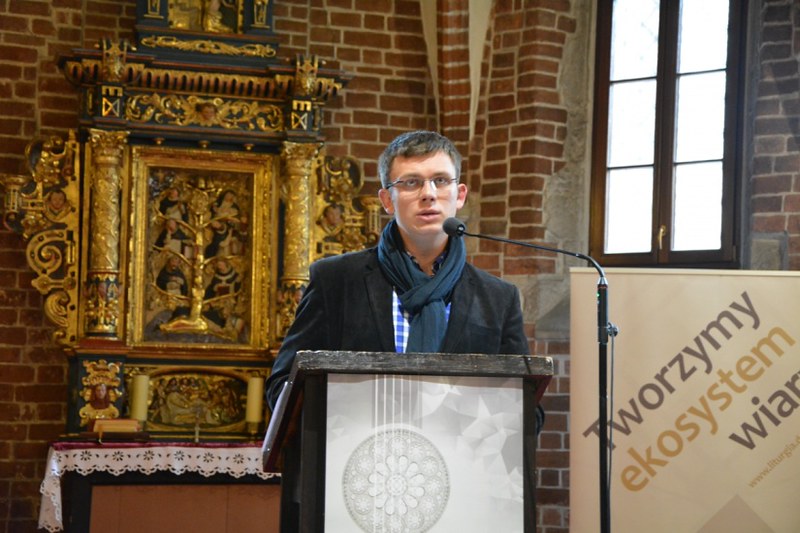
The second day promised to be very intensive, and it was. We started early – for a popular-science session – because at 8:30 a.m. Bartosz Izbicki gave a talk on the “song of the people”, that is, traditional folk singing and its use in the Mass. He illustrated his talk with many musical examples. His thorough analysis focused mainly on outlining questions that need reflection, research and resolution. He also pointed out issues that call for greater awareness among cantors and organists who want to use traditional chants. In the second talk Rafał Maciejewski gave organists a few practical tips to help them do their work better and with greater commitment. As a trained singer and practising organist he has applied many of them himself and tested which ones bring us closer to the goal: deeper knowledge, a wider repertoire and, finally, getting the faithful to sing. Fr. Błażej Matusiak OP gave a talk on using the music of the great masters in the liturgy. The repertoire of early music – the treasury of the Church’s polyphony – is extremely rich, full of timeless works that still move the hearts and minds of listeners. The problem, however, is that the forms of early music do not fit the present shape of the rite of Mass. A significant part of the talk was devoted to counter-arguments against the reasons given for rejecting the old works. The speaker argued that despite the difficulties the works of the old masters can be successfully used in the liturgy as it is celebrated today. After the lecture the Collegium Palestrinae ensemble performed three late-Renaissance pieces by di Lasso and Palestrina. The quality of the performance meant that the participants not only did not want to reject the works of past ages but wished to hear them in the liturgy. During the Mass that divided the two parts of the session, the Lege Artis ensemble conducted by Agnieszka Trela-Jochymek sang, joining the Dominican friars who celebrate Mass every day at noon. After Mass and a break we took part in a panel on the use of early music in the liturgy. Fr. Matusiak and R. Maciejewski were joined by Antonina Karpowicz-Zbińkowska, Henryk Krawczyk (organist of the Basilica of the Holy Trinity in Kraków), Fr. Wojciech Sznyk OP and Daniel Wierzejski, who not only led the discussion in a very relaxed style but also explored the subject with apt and searching questions.
After the panel we moved on to the last part of the session, which dealt with contemporary attempts to find ideal liturgical music. First Jakub Kubieniec presented the achievements of the Sistine Chapel Choir. With a good deal of humour and great competence he described the characteristic features of the papal choir’s singing and repertoire. He did not seem to think, however, that the Choir had reached the ideal. Then Michał Sławecki gave a musicological analysis of selected pieces from the Niepojęta Trójco songbook. We expected a crushing review because, despite its obvious success, the songbook still meets with criticism from experts. This time, however, we were pleasantly surprised. The talk balanced appreciation for our publication with criticism that concerned only individual compositional mistakes. Some of them – according to the speaker, a composer by training – could be justified by a particular stylization, while others resulted from a clear oversight or error. During the talk he said something that particularly surprised and pleased us: that the songbook should be “the Bible of every liturgical schola”. The analysis of pieces from the songbook was illustrated by the Lege Artis ensemble, which sang both the original versions and those modified by M. Sławecki for the lecture. Finally we heard a talk by Antonina Karpowicz-Zbińkowska, which the organizers intended as a summary of the session. The Warsaw theologian of music presented the features of ideal liturgical music. Drawing on the works of Cardinal Joseph Ratzinger, she proposed solutions that were not so much practical as theoretical and spiritual. In her theses we found statements very close to us, which are already the aims of our Center’s work, as well as theses we will gladly include in our mission. The last item on the programme was a panel on composing liturgical music. Unfortunately Paweł Bębenek could not come, but the discussion was still very interesting and not without controversy. It was led by Paweł Kisiel, cantor of St. Mary’s Basilica in Kraków, with the session’s speakers taking part (J. Kubieniec, M. Sławecki, B. Matusiak OP and T. Grabowski OP).