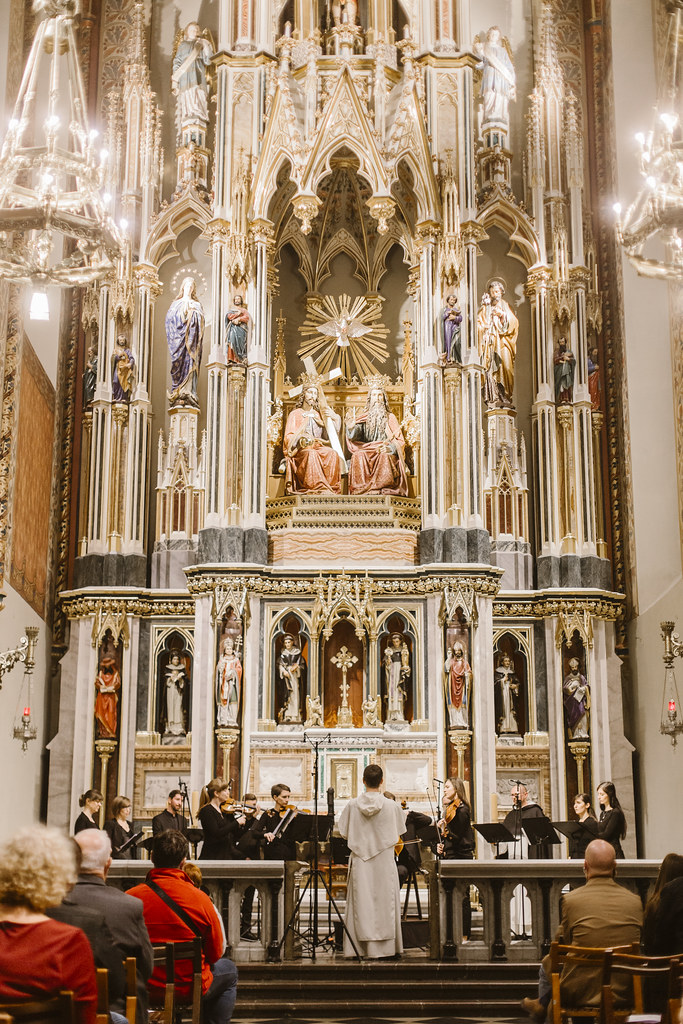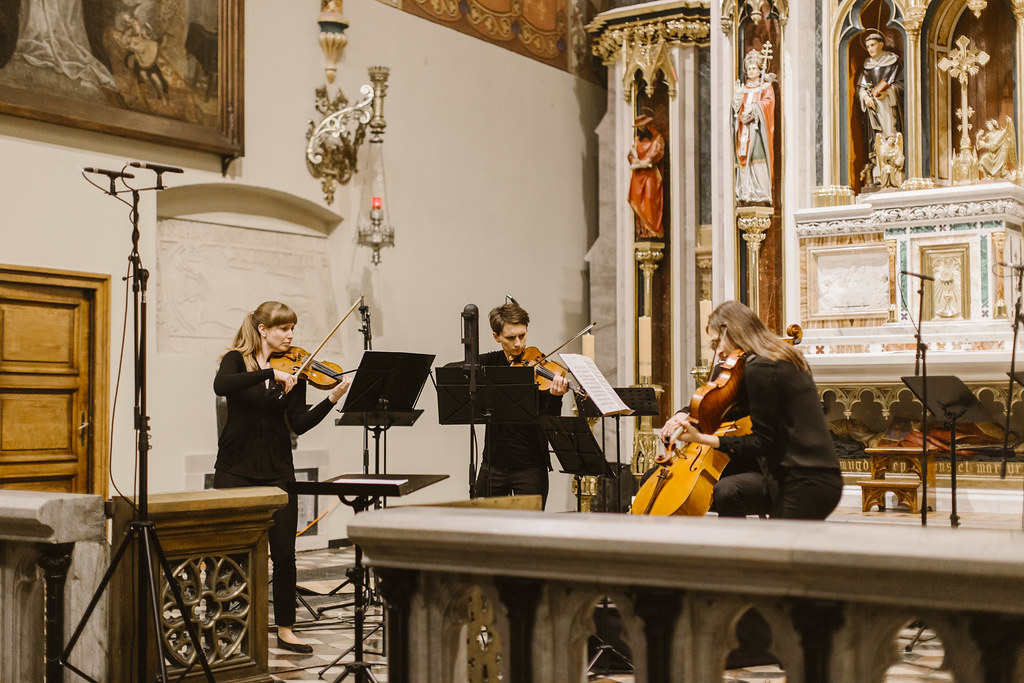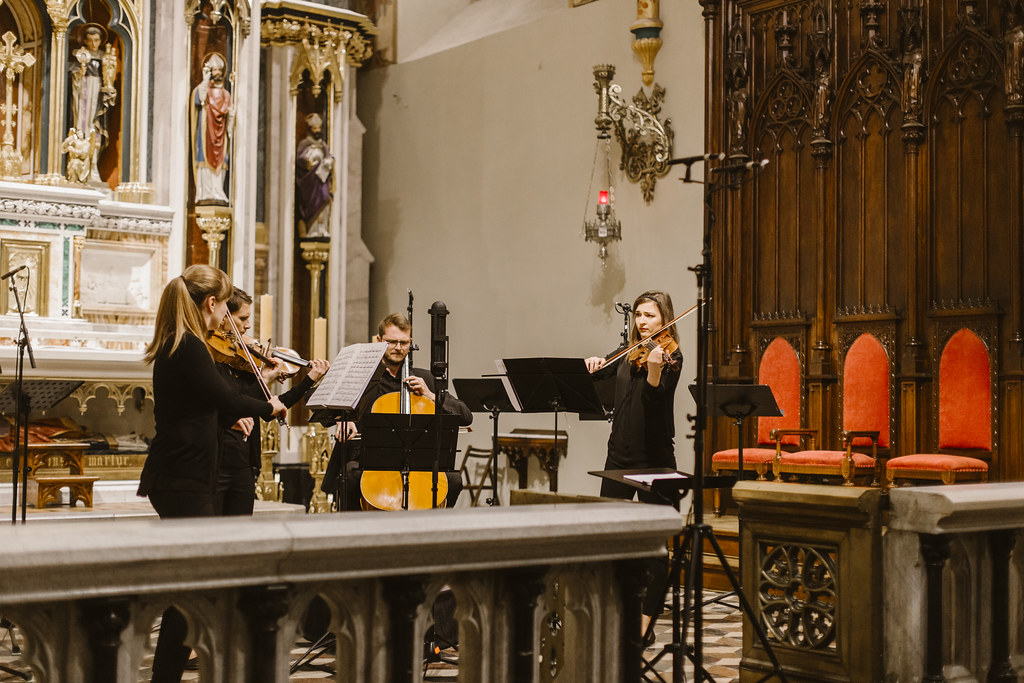

On Saturday, September 25, 2021 at 8:30 p.m., we invite you to a concert during which the new composition by Dawid Kusz OP “Miserere mei Deus” for vocal octet and string quartet will be presented. At the beginning, the Airis String Quartet will perform Anton Webern’s “Langsamersatz”.

Psalm 51 (Miserere mei Deus) is one of the most musicalized texts in the Bible. From the Renaissance to the present day, it has received many musical interpretations; the works of Gregorio Allegri, Josquin des Pres and Carl Gesuald da Venosa delight and move to this day.
An interesting fact is that in Polish music the best-known examples of musical interpretations of Psalm 51 do not occur until the second half of the 20th century. The text of the psalm was used by composers such as Witold Szalonek, Paweł Szymański or Stanisław Krupowicz. The earlier writings of Psalm 51 are either forgotten or little known. The resulting work is therefore to fill a certain “gap”, which is undoubtedly a relatively small number of musical interpretations of the psalm in our native culture against the background of European and world music.
The process of creative perception was preceded by careful study of the very text of Psalm 51. Contemporary exegesis offers several different interpretations of the Miserere psalm. The most insightful research on the text of the psalm was carried out by Gianfranco Ravasi in his work Il Libro dei salmi (Bologna 1986). The Italian researcher proposed an interesting concept of a philological and theological interpretation of the psalm, which became a direct inspiration for its musical arrangement.
Ravasi, examining the content of the psalm, proposed the linguistic aspect of the text as a starting point, looking for repetitions, similarities, and mutual relations. This allowed him to divide the text of the psalm into three sections: Section I – verses 3-11; Section II – verses 12-14 and Section III – verses 15-21. Then, while examining the structure and meaning of Miserere‘s text, he found hidden sequences within both sections.
In the first section of the text (vv. 3-11), he noticed a certain concept in composing the text, which he called a “concentric structure”. It basically means that the final verses of the sections correspond with each other in terms of content, terminology, tenses used, and the centre of the discussed structure becomes verse 6b.
The above-mentioned structure can perfectly stimulate the composer’s imagination. The parallelisms discovered by Ravasi may lead to the use of similar melodic, harmonic material in adequately corresponding verses, and the centre of the concentric structure can be musically imagined as the culmination of the piece.
He also found the structure that organizes the second section of the psalm in the so-called “small epiclesis”, the structure of which is as follows: God’s call – a request for God’s spirit.
V.12 Create in me a pure heart, Oh God, and renew a
steadfast spirit within me.
V.13 Do not cast me [God] from your presence or take your
Holy Spirit from me.
V.14 Restore to me [God] the joy of your salvation and grant me a
willing spirit, to sustain me.
The second part, kept in a contemplative character, is based on the aleatoric technique, symbolizing here “the breath of God’s Spirit”. The third section of the Psalm, Ravasi called “liturgical appendix”, because the final verses of the Psalm clearly refer to the Old Testament liturgy of sacrifice.
The musical material was composed in such a way as to refer to liturgical practice in its pronunciation; each verse ends with a similar melodic structure (“refrain”), which is a reference to the liturgical responsorial psalm.
Performers: 1st vocal quartet: Maria Klich, Łucja Nowak, Piotr Windak, Jakub Ciępka; 2nd vocal quartet: Maria Babicz, Justyna Łokcik, Łukasz Miśko OP, Grzegorz Szulik and the Airis String Quartet: Aleksandra Czajor – 1st violin, Grażyna Zubik – 2nd violin, Malwina Tkaczyk – viola, Mateusz Mańka – cello. To start with, the quartet will perform Anton Webern’s “Langsamersatz”.